Certificate of authenticity or forensic handwriting report: which do I need?
The differences between a certificate of authenticity and a forensic handwriting report, when each is appropriate, what material is needed and what the law says.
Contents
When a question arises about a signature, the first thing to decide is which document you need: a certificate of authenticity or a forensic handwriting report. Both start from an examination of the handwriting, but they meet different needs, take different forms and cost different amounts. Choosing correctly saves you money and time.
The difference in one sentence
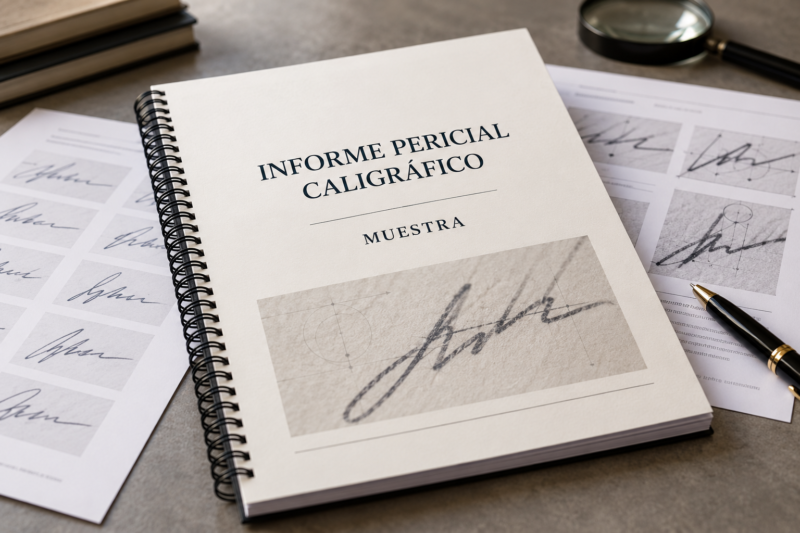
The certificate accompanies an item (an autograph, a historical document, a letter) to attest to its authenticity for buyers, auction houses or insurers. The expert report resolves a dispute over a signature or document (a contract, a will, a cheque) with a full study that can be defended before the other party and, if necessary, before a judge.
| Certificate of authenticity | Forensic handwriting report | |
|---|---|---|
| Purpose | To sell, buy, insure or document an item | To resolve a dispute over a signature or document |
| What is examined | The item, against period reference signatures | The questioned document against known specimens from the case |
| Format | A short document with a verifiable number | A full study: purpose, material, method, analysis, conclusions and limitations |
| Who uses it | Collectors, dealers, auction houses, heirs | Individuals, companies and lawyers |
| Indicative price | From €75 | Tailored quote |
When you need a certificate of authenticity
- You are going to sell an autograph or signed document and want the buyer to trust it.
- You are going to buy an expensive item and want an independent opinion before paying.
- You have inherited letters or documents and want to know what you have before dividing, selling or insuring them.
- You need to document an item for insurance or an inventory.
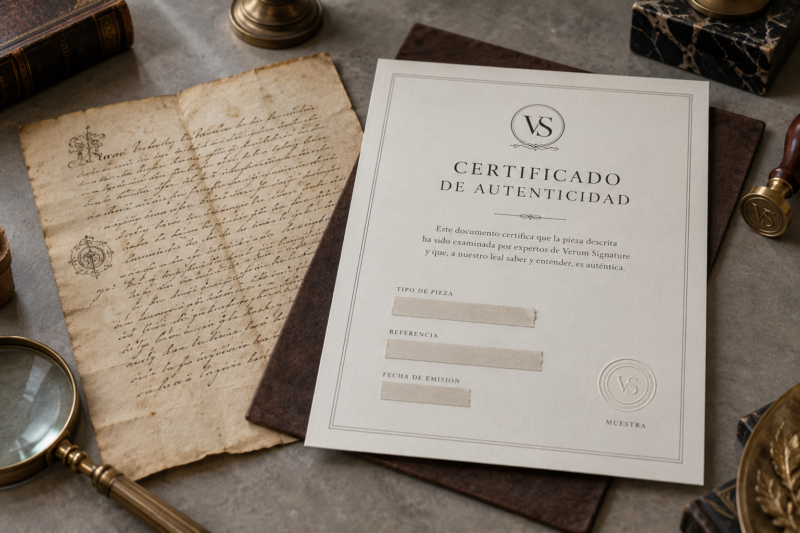
The VS Certificate identifies the item with its photograph, records the technical conclusion and carries a number anyone can check in the verifier. It can be physical + digital (examination of the original) or digital only (examination from photographs, with limited scope).
When you need a forensic handwriting report
- Someone denies having signed a contract, a loan or a receipt.
- You doubt the authenticity of a holographic will or a signature on an estate document.
- You suspect your signature has been forged on a cheque, a promissory note or an authorisation.
- The author of an anonymous letter needs to be identified, or alterations in a document detected.
Here a short conclusion is not enough: the report must explain the method, show the comparison with the known specimens and state its limitations, so that the other party, their lawyer or a judge can assess it.
What Spanish law says about expert reports
In Spanish civil proceedings, the Civil Procedure Act (Ley de Enjuiciamiento Civil, LEC) regulates expert evidence. Some useful points:
- An expert opinion is appropriate when scientific, artistic, technical or practical knowledge is needed to assess relevant facts; the parties may submit one or ask for one from an expert appointed by the court (art. 335).
- The expert must declare, under oath or promise to tell the truth, that they are acting with the greatest possible objectivity (art. 335.2).
- Party-appointed expert reports are, as a general rule, submitted with the claim or the defence (art. 336).
- Where there is no official qualification for the subject, the expert must be a person knowledgeable in it (art. 340).
- At trial, the parties may ask the expert for explanations and raise objections to their method and conclusions (art. 347).
My work is currently out of court: I prepare party expert reports for negotiating, making a claim or assessing a case. If the matter may end up in court, I will tell you from the outset so that your lawyer can assess the formal requirements, deadlines and ratification the proceedings require. Procedural rules differ from country to country.
What material is needed in each case
For a certificate
The original item (physical certificate) or high-quality photographs (digital certificate): front, back, a close-up of the signature and any seals or marks.
For an expert report
The document bearing the disputed signature, preferably the original, and several known signatures or writings by the same person from around the same date: ID documents, deeds, contracts, letters. With photocopies only a preliminary study with limited conclusions is possible, because a copy does not allow pressure, ink or fine strokes to be examined.
What if I don't know which I need?
Tell me about the case and I'll advise you with no obligation. Sometimes what looks like a forensic case can be resolved with a certificate, and vice versa: what matters is that the document you order serves its purpose. More information on expert reports at forensic handwriting examination and on Aprende Grafología (in Spanish).
Frequently asked questions
Can a certificate of authenticity be used in court?
It can be submitted as a document, but to dispute a signature in proceedings the appropriate tool is an expert report with a methodology, comparison with known specimens and reasoned conclusions.
What are known specimens?
Signatures or writings whose authorship by the person is certain, preferably from dates close to the disputed document, used as a reference for the comparison.
How much does a forensic handwriting report cost?
It depends on the number of documents and the comparison material. I will send you a tailored quote with no obligation.
Not sure which you need?
Tell me about the case and I'll tell you, with no obligation, whether you need a certificate or an expert report.
Juan García Nicolás · Graphologist and forensic handwriting examiner
Trained at Ipsigrap, he personally signs every VS Certificate. Service in English and Spanish. More about me