How to authenticate a signature on a historical document
A step-by-step guide for owners and collectors: how to tell a handwritten signature from a facsimile, what to examine and when to get a professional opinion.
Contents
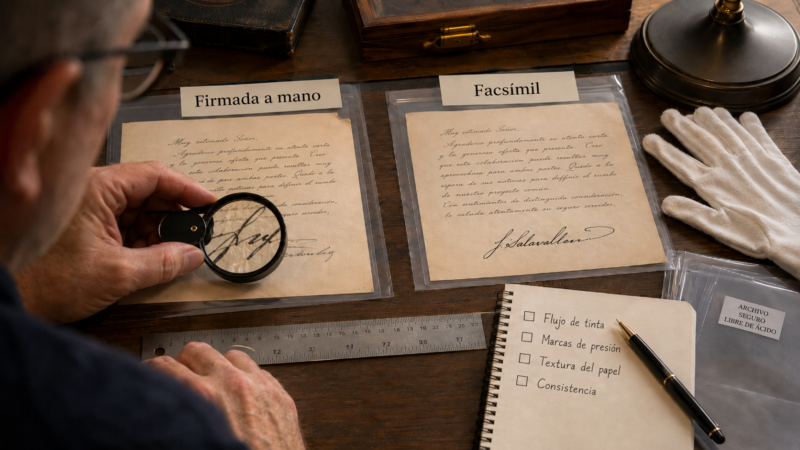
Authenticating a signature is not just a matter of recognising a famous name at the bottom of a letter, a certificate, a photograph or a historical document. A signature may be handwritten, facsimile, printed, stamped or simply attributed without sufficient evidence, and the conclusion must always match the evidence examined.
Anyone who wants a signature authenticated usually wonders whether that person really wrote that mark on that particular sheet. But it also matters whether the document is original, whether the signature is handwritten or reproduced, whether there is provenance and whether reliable comparisons exist. A serious certificate of authenticity is not just a card that accompanies the object: it identifies the item and explains the scope of the review. Best practice combines support, comparison, context and provenance.
What authenticating a signature means
Authenticating a signature means gathering and weighing the elements that allow a reasoned opinion on its nature, its likely authorship and the way it was applied. Not every item allows the same degree of certainty: some call for caution because of a lack of references or limitations of the material.
Responsible authentication distinguishes between terms that are not interchangeable:
| Term | What it means |
|---|---|
| Handwritten signature | Written by hand by the signatory on that support. |
| Facsimile signature | A reproduction of a real signature, printed or stamped. |
| Printed signature | Part of the printing of the document. |
| Secretarial signature | Handwritten, but by another authorised person. |
| Autopen | Written by a machine that reproduces a template. |
| "Attributed to" | Insufficient evidence to state authorship. |
| "Not assessed" | Not examined. |
1. Review the whole document first
Before looking at the signature, look at the whole document: paper, printing, typeface, date, seals, folds and language. Check that the person held the stated position on that date.
An attractive signature does not make up for an inconsistent document. And a genuine period document may carry a facsimile signature: the authenticity of the support and the handwritten authorship of the signature must be assessed as separate questions.
2. Determine whether the signature is handwritten or reproduced
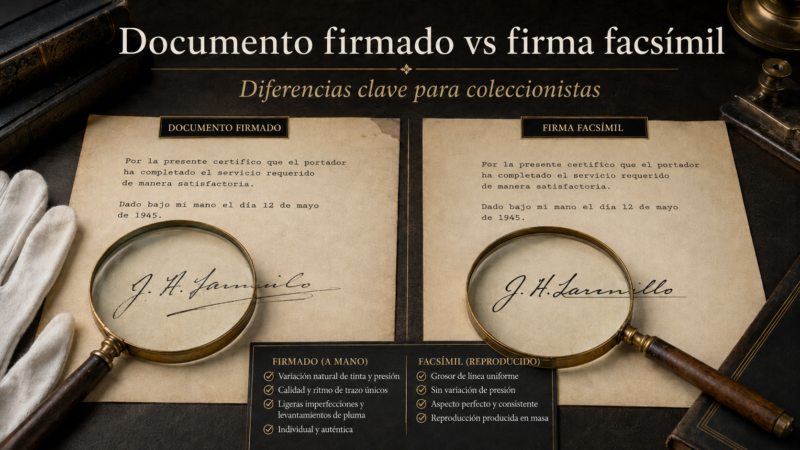
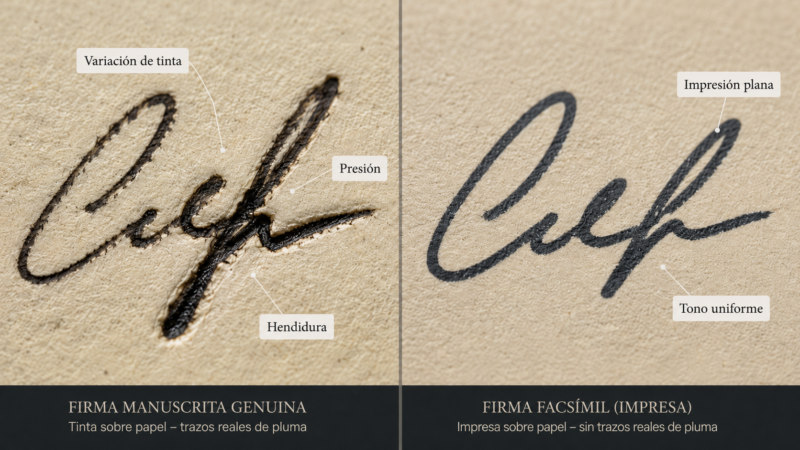
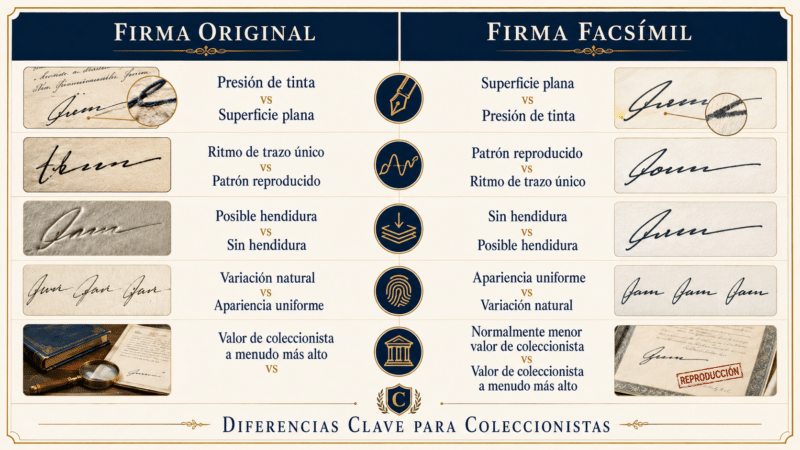
The first step is to establish how the signature was applied. A handwritten signature may show variations in ink, pressure and rhythm, and a physical relationship with the paper. A printed signature usually has flat coverage, a uniform tone or mechanical repetition.
There is no single test: some pens leave very regular strokes and some old printing is irregular. The conclusion must be based on several concurring observations. More details in the guide facsimile vs handwritten signature: how to tell the difference (in Spanish).
LOOKING FOR AN ORIGINAL SIGNATURE?
Explore the collection of autographs, signed documents and selected historical items at Autographs & Militaria.
3. Look at pressure, ink and edges
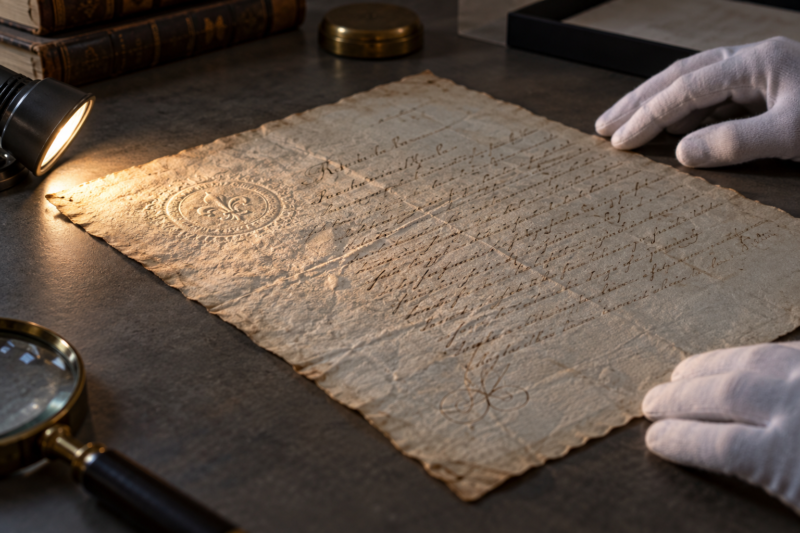
Under side (raking) light, a handwritten signature may show consistent indentations in the paper. The ink may penetrate unevenly or change in intensity along the stroke. A printed signature, by contrast, usually sits on a flat surface.
These physical marks must be interpreted with caution: several concurring details give a conclusion more weight than a single one.
4. Compare with reliable references
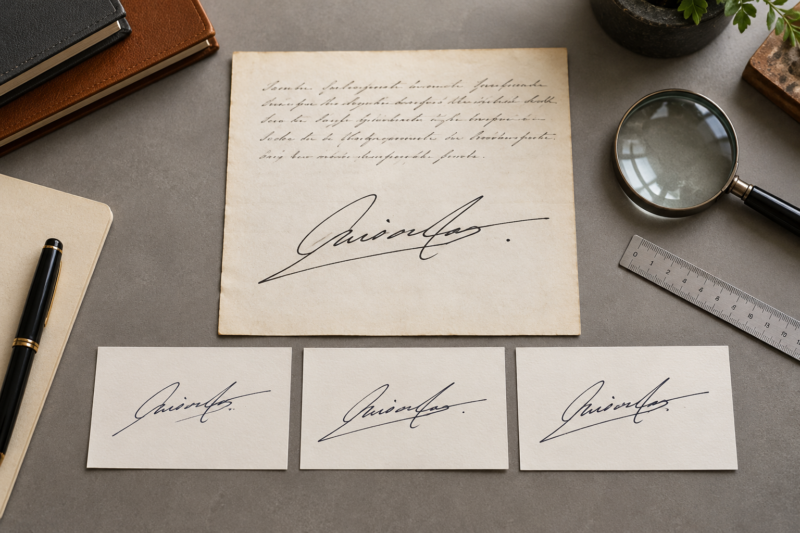
Comparison is the central tool. Use reliable examples, close in date and type of document: an image from the internet is not enough. Compare letters, initials, proportions, slant, connections, beginnings and endings.
Age, health, writing instrument and circumstances can change a signature. A difference does not necessarily mean forgery, but a significant difference must be explained before certifying.
5. Check repetition and the context of issue
With certificates, diplomas, institutional letters and forms, it is worth comparing several copies. If the signature looks absolutely identical on all of them, it may be a facsimile, a stamp or a printing system. That does not invalidate the document: it may be an official period issue.
A correct description separates documentary authenticity from autograph authenticity: "original period document with facsimile signature" is more accurate than claiming the person signed it personally. This distinction avoids mistakes and protects the buyer.
6. Assess provenance and chain of custody
Provenance describes where an item comes from and how it reached its current owner: invoices, catalogues, family archives, correspondence or collection labels. A documented chain of custody is particularly valuable.
Provenance does not replace technical analysis, but it provides context. Its absence calls for caution and further research.
7. Take photographs that allow the item to be reviewed
For an initial remote assessment you need complete, sharp photographs of the front and back, with close-ups of the signature, seals, edges and any damage. Use even lighting and avoid filters and strong reflections.
Photographs help rule out obvious problems, but they do not replace examination of the original: a compressed image can hide decisive details. That is why the digital-only certificate has a limited scope, and for valuable items I recommend a physical examination.
8. Distinguish authentication, valuation and certificate
Authenticating a signature is not the same as valuing the item. A genuine document may have limited monetary value because of its condition or how common it is; another may be expensive and call for caution if evidence is lacking.
A certificate of authenticity must be tied to a specific object and include a description, identifying images, dimensions, date and a precise conclusion. It should state what the evidence supports and avoid vague or absolute guarantees. This is what the VS Certificate looks like.
9. Decide when you need a professional opinion
A decorative or low-value item may only need clear photos and an honest description. A rare autograph or an expensive document deserves a deeper assessment, in which a professional reviews the support, printing, strokes, provenance, comparison material and historical context, and explains the evidence and its limitations in the report.
Before issuing a certificate, it is good practice to archive the photographs used, record the date of review, identify the owner and assign a unique reference to the item. These measures do not in themselves prove authorship, but they prevent the certificate from becoming separated from the object examined or later being used for another item. That is exactly what the VS verification register does.
Conclusion
Authenticating a signature requires method, comparison and honesty. It is not enough for the signature to look right: support, ink, pressure, context, repetition and provenance must all be studied. A facsimile signature may belong to a legitimate historical document, but it must be described as such; a handwritten signature also needs evidence. The aim is to tell the true story of each item, and documenting it well protects owners, buyers and future researchers.
Frequently asked questions
How do I know whether a signature is handwritten or printed?
Under magnification and side lighting: a handwritten signature usually shows variations in ink, pressure and indentations in the paper; a printed one, flat and uniform coverage. No single sign is conclusive on its own.
Can a signature be authenticated from photos alone?
An initial assessment is possible, but with limited scope. For a firm conclusion the original must be examined.
Does an original document guarantee that the signature is autograph?
No. Many official period documents carry facsimile or stamped signatures. They are separate questions.
Would you like to certify a signature?
Send me a few photos and I'll tell you what certification costs. The preliminary assessment (€25) is deducted from the price of the certificate. Physical + digital or digital-only certificate, with a verifiable number.

Juan García Nicolás · Graphologist and forensic handwriting examiner
Trained at Ipsigrap, he personally signs every VS Certificate. Service in English and Spanish. More about me