Buying historical documents in Spain: legal guide and 9 checks
What Spanish law says about documentary heritage, how the State's right of pre-emption works at auctions, when you need a permit to take a document out of Spain and what to check before you pay.
Contents
Buying historical documents in Spain is a fascinating way to connect with the past: a handwritten letter, a military appointment, a notarial deed or a signature on old paper links you directly to people and events of another era. Spanish auction houses and dealers offer many such items, including to buyers abroad. Before paying, though, answer three separate questions:
- Can it legally be sold, bought and taken out of Spain?
- Is it authentic and correctly described?
- Where does it come from and how did it reach the seller?
They are related but not interchangeable. A signature can be genuine while the ownership of the document is in doubt. An item can come with an invoice and a wrong attribution. And a certificate of authenticity gives an opinion on the signature; it does not settle the legal status of the document.
This article is for information only and is not legal advice. If you have doubts about ownership, provenance or export, consult the competent Spanish authority and, where appropriate, a specialist lawyer.
1. A real case: the State buys 32 bundles of papers at auction
On 24 September 2026, the Madrid auction house El Remate offered as lot 357 a leather-bound volume containing 32 bundles of genealogies, inventories, entails, censuses and sale deeds of several families, dated in Valladolid between 1517 and 1697, three of them on parchment.
Through Order CLT/1125/2026, published in the Spanish Official Gazette (BOE) on 27 October 2026, the State exercised its right of pre-emption (derecho de tanteo): it paid the hammer price (550 euros, plus costs and VAT) and assigned the lot to the Archivo Histórico de la Nobleza, a State archive.
Two lessons: a document's interest for a public archive does not depend on a high price, and winning the bidding does not always mean taking the lot home.
2. Is it legal to buy historical documents in Spain?
Yes. Private sales of historical documents exist and are legitimate: age does not mean a sale ban or public ownership. But it cannot be assumed that any old document may be sold, bought or exported without checking its status. You should know:
- who owns it and whether the seller can transfer it;
- whether it comes from a public archive or a notarial register;
- whether there is any claim, protection order or restriction;
- whether it forms part of the Documentary Heritage;
- whether it will leave Spain.
The key reference is Law 16/1985 on Spanish Historical Heritage (in Spanish), although Spain's autonomous regions also have their own rules.
3. Which documents form part of the Documentary Heritage?
Article 49 of the law defines «document» broadly: any expression in natural or conventional language and any other graphic, sound or image expression, on any medium. It distinguishes these groups:
| Type of document | Part of the Documentary Heritage… |
|---|---|
| Produced, kept or gathered by public bodies in the exercise of their functions | Of any age (art. 49.2) |
| From political, trade-union or religious entities, and private cultural and educational entities, foundations and associations | Over 40 years old (art. 49.3) |
| From other private entities or individuals | Over 100 years old (art. 49.4) |
| More recent documents of special value | If the State declares them part of it (art. 49.5) |
Being part of the Documentary Heritage does not mean the document belongs to the State: it can remain privately owned. It does carry obligations, such as preserving it, allowing inspection and complying with the rules on sale and export.
4. What is the right of pre-emption at an auction?
The right of pre-emption is a preferential right to acquire: in the cases set out in the law, the Spanish authorities can acquire an item of the Historical Heritage for the same price agreed or reached at auction. To make this possible, auction houses must give advance notice of sales of such items.
For a collector, the result can be:
- You bid and reach the hammer price.
- The authorities exercise pre-emption under the procedure.
- The lot goes to a public institution for that same price.
It is not confiscation: the State pays the price. And not every auction of old documents ends this way. If you are particularly keen on an item, ask the auction house which conditions apply.
5. The Cervantes case: a genuine document with a long ownership dispute
The best example of the difference between authenticity and ownership is a receipt signed by Miguel de Cervantes in Seville on 8 July 1593, acknowledging 600 silver reales for sixty days of work on a commission.
- In 1998 it came up for auction in Barcelona. The Andalusian regional government claimed it, considering that it came from the notarial registers held at the Provincial Historical Archive of Seville, and the sale was halted.
- A court in Palma de Mallorca dismissed the claim in a ruling published in 2007, and the Provincial Court upheld it.
- In May 2026 it was announced again at auction in Madrid, with a starting price of 120,000 euros.
- On 14 September 2026, the Island Council of Mallorca opened proceedings to declare it an Asset of Cultural Interest (BOE, 1 October 2026). While the procedure is under way, it enjoys the protection of declared assets.
The lesson: the question was not only whether Cervantes signed it, but also what kind of document it was, which archive it came from, how it left, what the courts decided and what protection it has today. Authenticity, provenance and ownership must be examined separately.
6. Documents from public and notarial archives: extra caution
Not every document that mentions a notary is an original from a public register: there are authorised copies, transcripts and documents handed to private parties. But ask questions if the item looks like:
- a page torn or detached from a notarial register;
- a document with stamps, shelf marks or references of an institutional archive;
- an item whose foliation shows it was part of a file;
- an original whose departure from the archive nobody explains.
Article 54 of Law 16/1985 allows the authorities to order the transfer to a public archive of public documents improperly retained by private persons or institutions. If you see these signs, «from an old collection» is not enough.
7. Taking historical documents out of Spain
This is the key point for buyers abroad. Under Spanish law, export means taking the item out of Spanish territory, including to another EU country. The basic rules of article 5 are:
- Items of the Spanish Historical Heritage over 100 years old, and those entered in the General Inventory, need prior and express authorisation from the State to leave Spain.
- Assets of Cultural Interest, and items expressly declared non-exportable, cannot be exported, save for the legal exceptions.
- Documents of the Documentary Heritage that are publicly owned cannot be exported (art. 56).
Before shipping an old letter, check its age, its legal status, whether the export is temporary or permanent and whether the destination is inside or outside the EU. Outside the Union, EU rules on categories and thresholds may also apply. Do not rely only on the date in a listing, and do not agree to shipping before confirming that it is allowed.
Note: in some permanent export applications, the declared value may operate as an offer to sell to the Spanish authorities. For important items, understand the procedure before applying.
LOOKING FOR HISTORICAL DOCUMENTS WITH PROVENANCE?
Browse the historical documents at Autographs & Militaria and see how their authenticity and provenance are documented.
8. Authenticity, provenance and legality: three different questions
| Question | What it clarifies | Useful information |
|---|---|---|
| Is it authentic? | Whether the signature, document or attribution is what is claimed. | Comparison, material examination, reliable references. |
| Where does it come from? | The history and previous owners of the item. | Invoices, catalogues, inventories, correspondence. |
| Can it be sold or exported? | The legal regime of the sale or shipment. | Ownership, protection, authorisations. |
An item can pass one test and leave another open. The case of the forged Hitler diaries also shows why a convincing story or similar handwriting is not enough.
9. Nine checks before buying historical documents in Spain
- Identify what is being sold. Handwritten letter, typed document with signature, copy, cut signature or print with a facsimile signature.
- Ask for complete photographs. Front, back, stamps, margins, damage and annotations.
- Identify the seller and keep all communications.
- Request the available provenance: invoices, auction catalogues, previous collections. Record an oral account as such.
- Look for signs of public or notarial origin: shelf marks, foliation, archive stamps, torn pages.
- Ask about known restrictions: protection orders, claims or export limits.
- Check authenticity of the signature and the document. See how to authenticate a signature.
- Read the scope of the certificate: who signs it, which item it identifies and what was examined. A VS Certificate can be checked in the verifier.
- Keep the invoice, photos and messages: they do not replace an authorisation, but they rebuild your purchase history. How to store them: how to preserve autographs.
Extend this list with our guide on how to buy an autograph safely.
Conclusion
Buying historical documents in Spain is legitimate and rewarding if each item is studied without automatic answers. The pre-emption of the Valladolid papers and the long story of the Cervantes receipt show that a purchase can raise questions of public interest, provenance, ownership and movement.
Before buying, ask for information. Before attributing a signature, study the evidence. And before sending a document abroad, check whether it needs authorisation.
Frequently asked questions
Can I buy an old signed letter in Spain?
Yes. Legitimate private sales exist. Before buying, check ownership, provenance, description and any restrictions.
Does every document over 100 years old belong to the Spanish State?
No. A private document over 100 years old is part of the Documentary Heritage but can remain privately owned. Its specific status must be checked.
Can the State take a lot even if I was the highest bidder?
Yes. In the cases provided for by law, the authorities can exercise the right of pre-emption and acquire the lot at the hammer price.
Do I need a permit to ship an old document from Spain to another EU country?
It depends on the item. Under Spanish law, export means leaving Spain, including to the EU; items over 100 years old need prior authorisation.
Does a certificate of authenticity allow me to export the item?
No. A certificate states a conclusion on authenticity; it does not replace an administrative export authorisation.
Sources
- Ley 16/1985, de 25 de junio, del Patrimonio Histórico Español (consolidated text, BOE), arts. 5, 49, 54 and 56.
- Orden CLT/1125/2026, exercising the right of pre-emption over lot 357 (BOE, 27/10/2026).
- Announcement of the Island Council of Mallorca opening proceedings to declare the Cervantes receipt an Asset of Cultural Interest (BOE, 01/10/2026).
- El Debate (18/05/2026). Una carta firmada por Cervantes en 1593 sale a subasta en Madrid.
- Real Decreto 111/1986, implementing Law 16/1985 (export and sale).
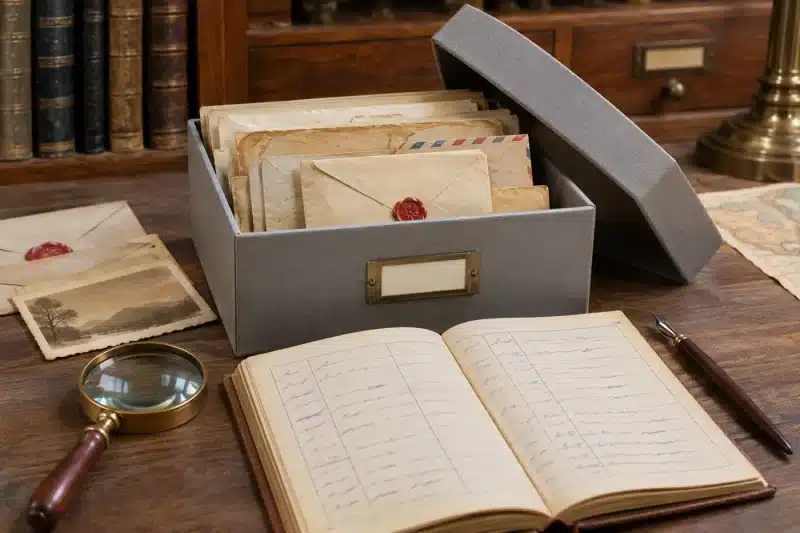
The images are AI-generated illustrations and do not show real historical documents.
Buying or already own a historical document?
Send me a few photos and I'll tell you what certification costs. The preliminary assessment (€25) is deducted from the price of the certificate. Physical + digital or digital-only certificate, with a verifiable number. Service in English and Spanish.
Juan García Nicolás · Graphologist and forensic handwriting examiner
Trained at Ipsigrap, he personally signs every VS Certificate. Service in English and Spanish. More about me