The forged Hitler diaries: 9 keys to the great hoax
In 1983 a magazine announced the discovery of Hitler's personal diaries. Two weeks later, the German Federal Archives declared them fake. What happened, how the forgery was uncovered and what the case teaches anyone buying a signed document.
Contents
The forged Hitler diaries caused one of the biggest documentary scandals of the twentieth century. The news went around the world and promised a new window into the history of the Third Reich. A few days later, examination of the notebooks showed that they were modern forgeries.
The case is especially useful for collectors of autographs and historical documents because it shows something fundamental: a convincing provenance and apparently matching handwriting are no substitute for a full examination of the item.
1. The 1983 news: diaries supposedly lost
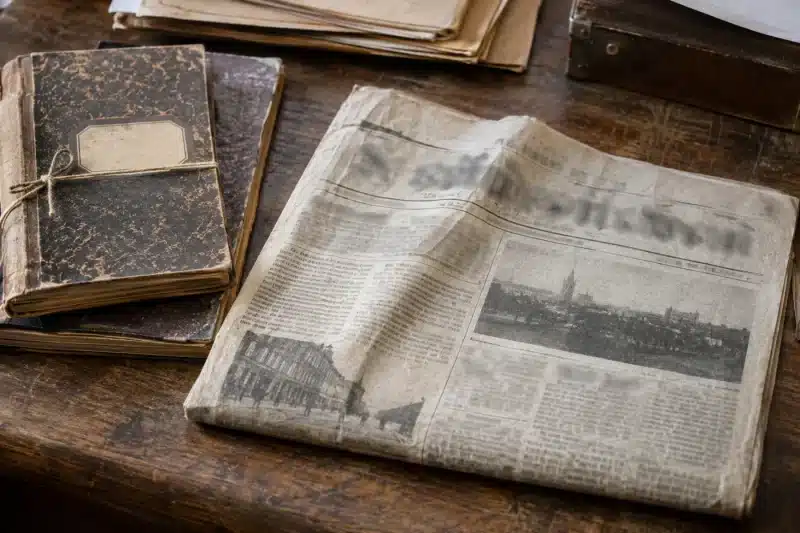
On Friday 22 April 1983, the German magazine Stern announced that it held 60 volumes of Hitler's diaries. It brought forward its issue 18/83, «Hitlers Tagebücher entdeckt» («Hitler's diaries discovered»), to Monday 25 April. That same morning it showed several notebooks at a press conference in Hamburg, where some experts already voiced doubts.
Had they been genuine, the diaries would have been a historical source of enormous interest. That was precisely the danger: the appeal of a discovery does not prove its authenticity. An item can be highly desirable and still lack any basis for attributing it to its supposed author.
According to the Bundesarchiv's account, the institution learned of the 60 volumes at the same time as the public.
2. Who forged the Hitler diaries?
The forger was Konrad Kujau. Stern journalist Gerd Heidemann acted as intermediary and, according to the Bundesarchiv, was the only person in direct contact with Kujau. Heidemann was fully convinced that the documents were genuine.
The case should not be reduced to «an expert looked at the handwriting and exposed the fraud». The investigation brought together documents, people, materials and checks by several institutions. Roles must also be distinguished: whoever creates a forgery, whoever sells it, whoever announces the find and whoever examines it can be different people.
For a collector, the practical lesson is clear: an item can pass through several hands and acquire an ever more convincing story without that story proving where it came from.
3. Provenance: an attractive story is not a documented chain
Provenance is the known history of an item: where it came from, who kept it and how it reached its current owner. It may include invoices, auction catalogues, correspondence, collection inventories, family papers, old photographs or archive records.
A verbal account is also information, but it must be identified as such. «The seller says the item comes from a family archive» is not the same as «the family provenance is proven». The second statement requires documents.
Incomplete provenance does not prove forgery
Avoid the opposite mistake too. Many old documents have passed through inheritances, house moves or private sales and have lost part of their history. Missing documentation does not prove that an item is fake: it means part of its story remains unverified and the conclusion must reflect that.
4. Why examining the complete notebooks mattered
The Bundesarchiv's account contains a decisive detail. Between April 1982 and April 1983, Stern had given the institution about a dozen loose documents. Only three came from the supposed diaries, and two of them were blank.
Paper and handwriting experts examined those sheets, but the material was not enough to reach an unequivocal conclusion. Once the notebooks were available from 25 April, proving the forgery was far easier.
- Examining a loose sheet is not the same as examining the whole.
- Examining a photograph is not the same as examining the original.
- Studying a signature is not the same as investigating the whole document.
- Reviewing one part does not mean the complete item has been assessed.
When you ask for a professional opinion, always ask what material was actually examined.
5. Materials and content were evidence too
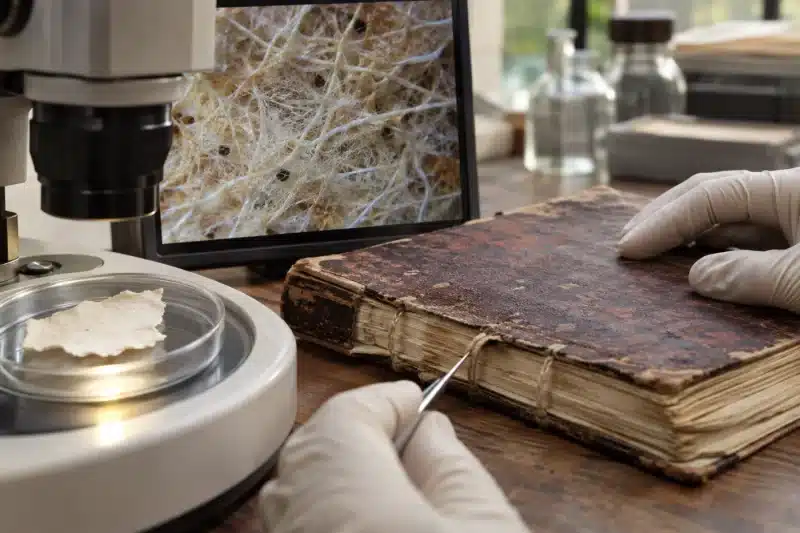
The notebooks went through several laboratories. The Federal Institute for Materials Research and Testing (BAM) received samples on 27 April, and the Federal Criminal Police Office (BKA) examined the volumes on 28 and 29 April. According to the Bundesarchiv, the bindings, sewing threads, paper and inks could not, for the most part, date from the Second World War. Archivist Josef Henke, who took part in the examination, added that paper whiteners unknown in Hitler's lifetime were detected.
The content failed as well. Henke documented errors no contemporary would have made: a law that was never enacted, a conversation with Hindenburg about a pardon he had already refused, a ministerial title not yet in use, and entries copied from published sources, mistakes included.
| Element | Question to investigate |
|---|---|
| Paper | Is it consistent with the attributed period? |
| Ink | What can be established about its characteristics? |
| Binding and threads | Are the materials consistent with the proposed date? |
| Handwriting | How does it compare with reliable specimens? |
| Content | Are there contradictory historical facts or anachronisms? |
| Provenance | Which parts of its history are documented? |
The lesson is not that any collector can date a sheet at home, but that a document has several components and each raises its own questions. One isolated answer rarely replaces examining the whole.
Does a reaction under ultraviolet light prove a document is fake?
Not on its own. Ultraviolet light can reveal, for example, optical brighteners, but interpreting it depends on the material, the type of document and its history. There is no household rule such as «if it glows, it's fake»: identifying and dating materials requires proper study.
LOOKING FOR AN ORIGINAL SIGNATURE?
Browse the collection of autographs and signed documents at Autographs & Militaria and see how their authenticity and provenance are documented.
6. Handwriting matters, but should not be studied alone
The most unsettling fact of the case is that, according to the Bundesarchiv, the handwriting in the diaries imitated known samples of Hitler's writing well. Henke recalls that in 1982 the Rhineland-Palatinate criminal police had considered that some papers appeared to be written by Hitler, and American and Swiss experts reached the same opinion at the time.
That is why a serious attribution starts by framing the question properly:
- Are we investigating whether a signature was handwritten?
- Do we want to know whether it belongs to a specific person?
- Is the whole document being studied?
- Could part of it have been added later?
- Are there reliable reference specimens?
A signature resembling an image found online deserves attention, but resemblance does not settle authenticity. Reference specimens must be assessed for provenance, quality and comparability: NIST recalls that they should be of the same type of writing, from a similar period and numerous enough to show natural variation. If the question is whether a signature is handwritten or printed, see our guide on how to authenticate a signature.
A document can contain elements from different periods
The same idea appears in the study of Leonardo da Vinci's handwriting: on one of his earliest drawings, the signature in the lower corner is considered apocryphal and probably added in the sixteenth century (article in Spanish). Signature, annotations and support must be examined separately before attributing them to the same person or period.
7. Can an expert be wrong?
Yes. Document examination is a specialised activity, but it is not free from error, as this case shows. The buyer's question should not only be «is there an expert?» but:
- What documentation has the expert examined?
- What comparison sources were used?
- Did they have access to the original?
- What exactly do they state?
- What limitations do they acknowledge?
- Does their opinion identify the specific item it refers to?
The NIST report on human factors in handwriting examination stresses the importance of training, documenting the process, quality control and how results are communicated. Recognising that error is possible does not diminish professional work: it shows how a conclusion was reached and what information could change it.
8. What a buyer should do before acquiring an important document
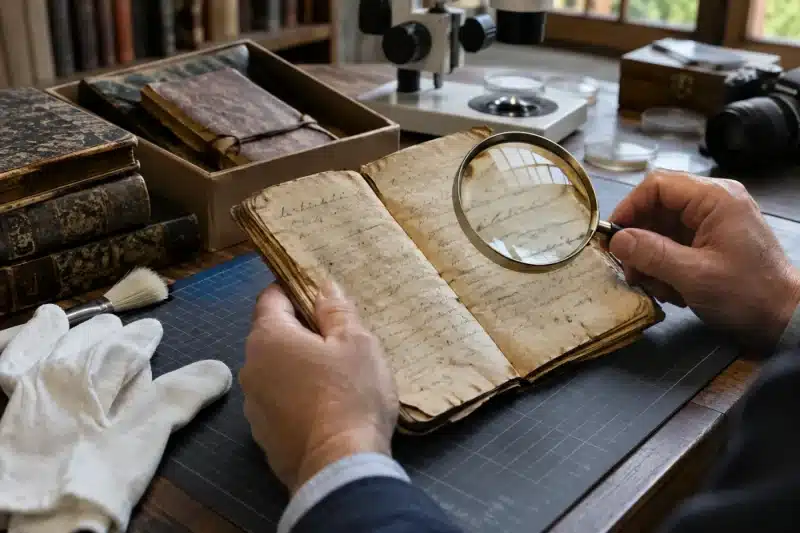
The forged Hitler diaries were an exceptional case, but they raise questions that apply to far more modest purchases:
- Ask for complete photographs. Front, back and relevant details: an enlarged signature does not show the document.
- Ask what is being sold. An original document, a reproduction, a signed photograph, a cut signature or an item with a facsimile signature.
- Request the available provenance. Distinguish documented facts from stories passed on.
- Check the scope of the certificate. It should identify the item and the person issuing the opinion, and state whether the original or only photographs were examined.
- Be wary of absolute claims without explanation. For important items, a second independent opinion may be sensible.
Read more in our guides on how to buy an autograph safely and buying historical documents in Spain.
9. What is a certificate of authenticity worth?
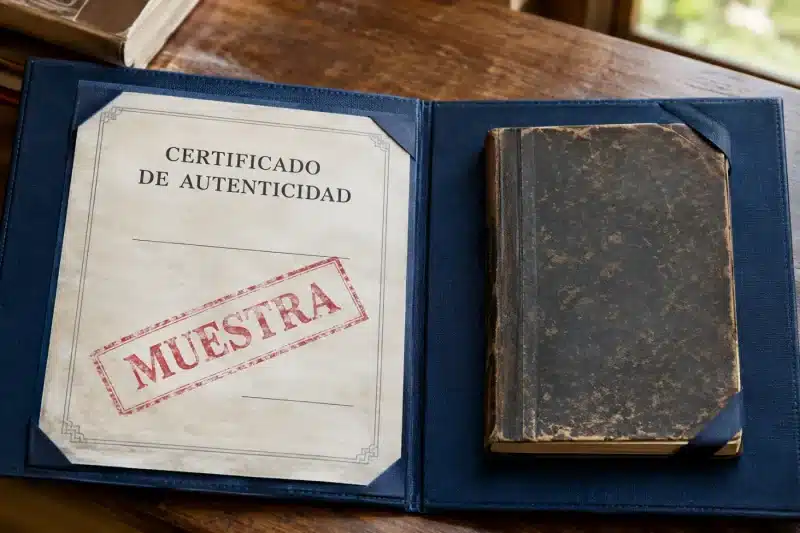
A certificate identifies an item and records the conclusion of whoever examined it, but it does not make a signature authentic. Its value depends on:
- who issues it and what expertise they bring;
- what material was examined;
- whether the item is clearly identified;
- what specific conclusion it states and what limitations it acknowledges;
- whether it can be checked with the issuer.
A certificate based on photographs and one based on physical examination of the original have different scopes. Read the whole document, not just the word «certificate». See how the VS Certificate works and verify a certificate. For the physical care of your items, read how to preserve autographs, and to organise a collection, the guide How to Catalogue a Historical Collection.
Conclusion
The forged Hitler diaries combined an extraordinary find, a provenance that was hard to verify, enormous public attention and handwriting that imitated the original well. The lesson for collectors is lasting: an item must be assessed as a whole.
A letter can bear a genuine signature added to a different document; an original document can bear a reproduced signature; an inscription can be later; and a certificate can exist without explaining what was studied. Before asking what an item is worth, ask: what do we really know about it, and how do we know it?
Frequently asked questions
When were the Hitler diaries announced?
Stern announced the find on 22 April 1983 and brought forward to 25 April the issue devoted to the supposed diaries, which it presented that day in Hamburg.
When was it revealed that they were fake?
The German Federal Archives stated publicly on 6 May 1983 that the documents could not be considered authentic.
Who was Konrad Kujau?
The forger who created the supposed diaries. Journalist Gerd Heidemann was his only direct contact with Stern.
Was the handwriting the only evidence?
No. In fact, the handwriting imitated Hitler's well. The analysis of the bindings, threads, paper and inks, and the historical errors in the content, were decisive.
Is it enough for a signature to look like a genuine one?
No. Visual resemblance can be a starting point, but attribution requires assessing the specimen, the references and the context.
Does a certificate guarantee there can be no error?
No. A certificate records its issuer's conclusion and should be judged by its scope, its reasoning and how it identifies the item.
Sources
- Bundesarchiv. Pressekonferenz des Bundesarchivs zu Hitler-Tagebüchern (press conference of 6 May 1983).
- Henke, J. (1984-1985). Revealing the Forged Hitler Diaries. Archivaria, 19.
- Expert Working Group for Human Factors in Handwriting Examination (2020; rev. 2021). Forensic Handwriting Examination and Human Factors. NISTIR 8282, NIST.
- NIST (2021). Handwriting Examiners in the Digital Age.
The images are illustrative recreations and do not reproduce the original notebooks.
Do you have a signature or historical document?
Send me a few photos and I'll tell you what certification costs. The preliminary assessment (€25) is deducted from the price of the certificate. Physical + digital or digital-only certificate, with a verifiable number. Service in English and Spanish.
Juan García Nicolás · Graphologist and forensic handwriting examiner
Trained at Ipsigrap, he personally signs every VS Certificate. Service in English and Spanish. More about me